
Plastic only accounts for 1% of Apple's product packaging, which will be completely replaced this year
author: Annie
2025-06-20
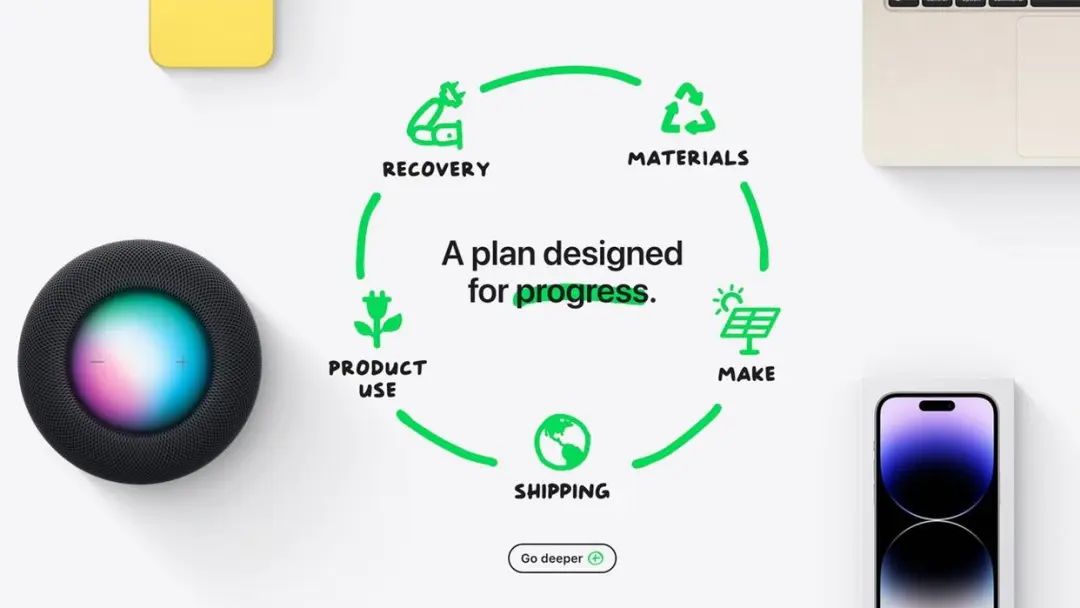
Recently, Apple CEO Tim Cook posted on Weibo that "Apple's global carbon emissions have been reduced by more than 60%, and the recycled materials and renewable energy we use have also reached a record high."
The relevant data shows a surprising data. At present, plastic only accounts for 1% of the packaging of Apple's full product line, and it is expected to be completely replaced this year. If you buy a new Apple product in the past two years, you may find that there is no plastic packaging film on the box, and the material used to wrap the product and accessories in the box is not the common plastic paper.
In 2020, Apple announced the "Apple 2030" plan, which plans to achieve the ambitious goal of carbon neutrality for all businesses by 2030. Apple has currently achieved carbon neutrality at the global corporate operation level, and will next cover the entire manufacturing supply chain and product life cycle, which will mean that Apple's supply chain companies will also achieve plastic-free packaging materials.
As early as 2015, Apple and the environmental protection organization The Nature Conservancy announced on the 16th that the two parties had cooperated to buy a total of 36,000 acres of forests in Maine and North Carolina in the United States to provide a stable supply of wood for the renewable paper used in product packaging boxes.
Apple believes that paper should be treated with the attitude of treating energy. The company hopes to use 100% sustainably managed and controlled wood to complete the production and manufacturing of product packaging boxes.
In recent years, Apple has turned to investing in Brazilian eucalyptus farms, hoping to absorb carbon dioxide with the help of this fast-growing tree.
In recent years, Apple has turned to investing in Brazilian eucalyptus farms, hoping to absorb carbon dioxide with the help of this fast-growing tree.
At the same time, since the tariff between Brazil and the United States is only 10%, if both parties are willing to negotiate, it is not impossible for both parties to achieve zero tariffs in accordance with the US principle of reciprocal tariffs. Therefore, Apple has cooperated with the contract manufacturer Foxconn to plan to expand production facilities in Brazil to further reduce its dependence on China.
Brazil's assembly scale is currently small, mainly serving the South American market, but as Foxconn's investment in Brazil increases, its role may gradually expand.
In 2024, about 80% of iPhones will still be assembled in China, but India already accounts for about 14% of global iPhone production, and this proportion is expected to rise to 35%-40% this year. Vietnam is mainly used for the production of non-iPhone products such as AirPods.
As early as 2018, Apple had been removing its supply chain from China step by step, gradually reducing its dependence on Chinese suppliers. The Sino-US tariff war has directly led to about 40% of US market orders being transferred to foundries such as India, Vietnam and Brazil for processing.
However, as the political and economic relations between China and the United States further deteriorate, it is not ruled out that Apple will accelerate the transfer of its industrial chain.
Without several flagship environmental protection trend leaders such as Apple, HP, and Dell, the process of de-plasticizing packaging materials in mainland China may be further hindered. This is what worries paper and plastic people the most.
Opportunities and challenges--various trends are intertwined, and the packaging industry landscape is being reshaped
Green packaging "new darling": Can food-grade rPET plastic help brands achieve net zero goals?
Related Article

54% of young people are willing to pay extra! Revealing how premium packaging captivates the younger generation through "tactile appeal"!


Digital printing is showing strong growth momentum in the packaging sector, with folding carton packaging holding particularly immense potential. According to a report by Straits Research, the global folding carton packaging market reached a scale of $141.43 billion in 2022. It is projected to grow to $208.73 billion by 2031, with a compound annual growth rate of 4.42%.
Massive Data Reveals: How Digital Printing is Reshaping the Folding Carton Industry and Helping Brands Achieve Growth!
