
Technology Development Trends in the American Label and Packaging Industry
author: Annie
2025-10-03
Linnea Keane (current President and CEO of the Tag and Label Manufacturers Institute) pointed out that in 2025, the industry is experiencing a shift in consumer behavior and preferences, which is driving transformations in labels and packaging. At the same time, changes in consumer behavior are accompanied by technological advancements, normalization of demand, and regulatory pressures. Additionally, factors such as economic uncertainty triggered by the implementation of tariffs and challenges brought by generational shifts in the workforce are compelling label converters/printers to demonstrate flexibility in order to adapt to the ever-changing industry landscape.
In today's fast-paced and consumer-driven era, the role of the label and packaging industry is crucial—it is not only about product presentation but also closely tied to sustainability, brand identity, and consumer safety. Over the past year, despite numerous new challenges, the label and packaging industry has consistently demonstrated remarkable flexibility and resilience.
Currently, the focus of label converters/printers and their suppliers has shifted to business management, cost control, improving internal operational efficiency, and revenue growth, while simultaneously striving to adapt to changes in consumer behavior and preferences. In recent years, inflation has significantly impacted consumers. Although inflation rates have now slowed down and even declined in some areas, consumer spending habits have already changed: they are spending less when shopping and, to save money, are switching from premium brands to private-label or store brands. This shift has triggered a chain reaction within the industry, affecting various segments and vertical markets, thereby driving changes in label types, materials used, production volumes, and many other aspects. The industry continues to adapt to the rapidly changing environment, demonstrating its flexibility every day.
Changes in consumer behavior are also accompanied by technological advancements, the normalization of demand across different markets and states, and regulatory pressures. Today, labels and packaging no longer serve merely functional purposes—they have become key components of brand strategy, product differentiation, and environmental responsibility.
Currently, the focus of label converters/printers and their suppliers has shifted to business management, cost control, improving internal operational efficiency, and revenue growth, while simultaneously striving to adapt to changes in consumer behavior and preferences. In recent years, inflation has significantly impacted consumers. Although inflation rates have now slowed down and even declined in some areas, consumer spending habits have already changed: they are spending less when shopping and, to save money, are switching from premium brands to private-label or store brands. This shift has triggered a chain reaction within the industry, affecting various segments and vertical markets, thereby driving changes in label types, materials used, production volumes, and many other aspects. The industry continues to adapt to the rapidly changing environment, demonstrating its flexibility every day.
Changes in consumer behavior are also accompanied by technological advancements, the normalization of demand across different markets and states, and regulatory pressures. Today, labels and packaging no longer serve merely functional purposes—they have become key components of brand strategy, product differentiation, and environmental responsibility.
The application of digital printing continues to advance
Digital printing technology continues to advance, its speed and functionality increasing. With its short-run capabilities, customization advantages, and faster delivery cycles, digital printing has revolutionized the label industry. This technology enables brands to personalize labels and packaging, quickly responding to market demands and enhancing consumer engagement.
Consumer behavior is shifting, driven by both inflation and digitalization (e.g., digital consumer advertising). Digitalization is driving increased demand for personalization, a rise in the number of SKUs (stock keeping units), and the prevalence of smaller orders and short production runs. This has led to significant growth for smaller private labels—a trend that aligns well with the advantages of digital printing.
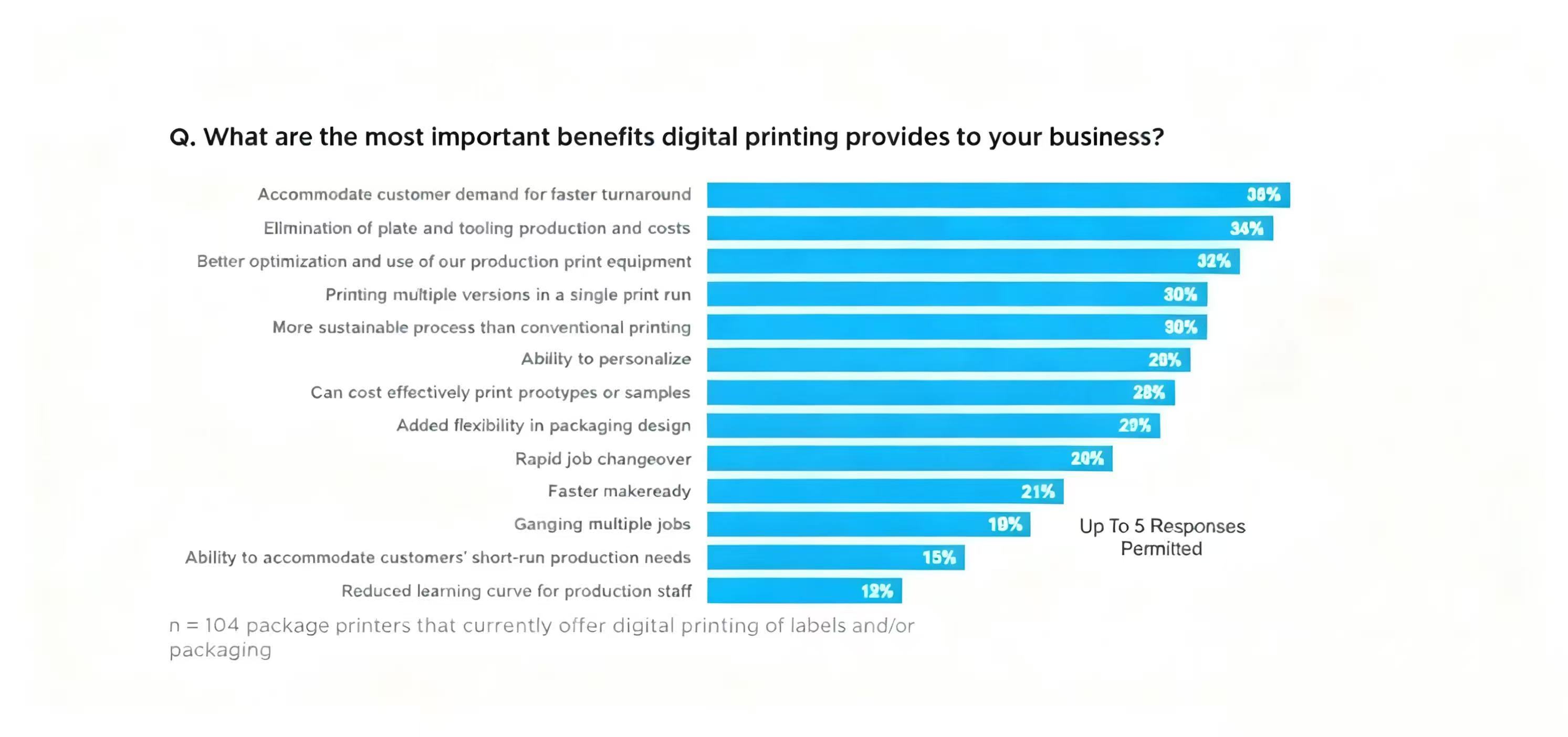
In a recent study conducted by Napco Research for the Label Manufacturers Association, respondents shared the advantages of digital printing in their operations. The majority of label converters have invested in digital printing equipment to expand their capabilities and meet growing customer demands. They cited benefits such as shorter delivery cycles and the elimination of printing plates and tooling as a key benefit (see Figure 1).
Consumer behavior is shifting, driven by both inflation and digitalization (e.g., digital consumer advertising). Digitalization is driving increased demand for personalization, a rise in the number of SKUs (stock keeping units), and the prevalence of smaller orders and short production runs. This has led to significant growth for smaller private labels—a trend that aligns well with the advantages of digital printing.
In a recent study conducted by Napco Research for the Label Manufacturers Association, respondents shared the advantages of digital printing in their operations. The majority of label converters have invested in digital printing equipment to expand their capabilities and meet growing customer demands. They cited benefits such as shorter delivery cycles and the elimination of printing plates and tooling as a key benefit (see Figure 1).
Advances in flexographic printing technology improve efficiency
Despite the rapid growth of digital printing, flexographic printing remains the dominant printing technology in label production, thanks to its vast existing equipment base and well-established infrastructure (see Figure 2). Flexographic printing continues to improve and upgrade its technology in terms of print quality, efficiency, and sustainability. For example, innovations such as LED-curable inks and advanced platemaking technologies ensure high printing standards while reducing environmental impact.
While label printers are investing in digital printing to expand their capabilities, this also increases operational complexity. This complexity is driving the demand for automated and platform-based production systems—investments in such systems can improve operational efficiency.
Automation and artificial intelligence (AI) have become key areas of focus for business owners and managers. Investing in automation is not only about improving operational efficiency but also a crucial means of addressing workforce challenges. Currently, low unemployment and a shortage of qualified labor are driving increased automation investment, and this trend is expected to continue.
Artificial intelligence remains a hot topic within the industry. The Label Manufacturers Institute (TLMI) has provided training on this topic through both in-person and online conferences. Many business managers are actively exploring how to integrate AI into their business strategies and operations. Although artificial intelligence will bring huge benefits to the industry, companies still need to go through a steep learning curve before applying this technology.
While label printers are investing in digital printing to expand their capabilities, this also increases operational complexity. This complexity is driving the demand for automated and platform-based production systems—investments in such systems can improve operational efficiency.
Automation and artificial intelligence (AI) have become key areas of focus for business owners and managers. Investing in automation is not only about improving operational efficiency but also a crucial means of addressing workforce challenges. Currently, low unemployment and a shortage of qualified labor are driving increased automation investment, and this trend is expected to continue.
Artificial intelligence remains a hot topic within the industry. The Label Manufacturers Institute (TLMI) has provided training on this topic through both in-person and online conferences. Many business managers are actively exploring how to integrate AI into their business strategies and operations. Although artificial intelligence will bring huge benefits to the industry, companies still need to go through a steep learning curve before applying this technology.
Other trends impacting the packaging industry
Alternative packaging solutions
For brands looking to influence consumer purchasing behavior, shelf appeal is crucial. Currently, a variety of packaging solutions are available on the market to meet these needs, including pressure-sensitive labels, stackable labels, in-mold labels, and shrink sleeves. Furthermore, packaging decoration technologies are constantly expanding, offering even more visually appealing effects and decorative techniques.
Among various label and packaging solutions, linerless labels, narrow-web flexible packaging, smart labels, and RFID technology are seeing increasing adoption. Linerless labels are functional solutions developed for specific applications, while narrow-web flexible packaging is gaining popularity to meet the needs of fast-moving consumer packaged goods (CPG) companies, who seek convenient packaging that ensures shelf life and enhances product appeal.
Smart labels equipped with RFID and NFC technologies can help brands track products throughout the supply chain, optimize inventory management, and provide interactive experiences for consumers. These technologies not only transform how brands interact with consumers and manage logistics, but also play a vital role in product anti-counterfeiting, traceability, and provenance tracking.
Furthermore, the GS1 Sunrise 2027 Project will drive the industry's transition to 2D barcodes. This transition will bring innovation and change to the labeling and packaging industry, accelerating the adoption of RFID technology and driving changes in label design.
Among various label and packaging solutions, linerless labels, narrow-web flexible packaging, smart labels, and RFID technology are seeing increasing adoption. Linerless labels are functional solutions developed for specific applications, while narrow-web flexible packaging is gaining popularity to meet the needs of fast-moving consumer packaged goods (CPG) companies, who seek convenient packaging that ensures shelf life and enhances product appeal.
Smart labels equipped with RFID and NFC technologies can help brands track products throughout the supply chain, optimize inventory management, and provide interactive experiences for consumers. These technologies not only transform how brands interact with consumers and manage logistics, but also play a vital role in product anti-counterfeiting, traceability, and provenance tracking.
Furthermore, the GS1 Sunrise 2027 Project will drive the industry's transition to 2D barcodes. This transition will bring innovation and change to the labeling and packaging industry, accelerating the adoption of RFID technology and driving changes in label design.
Sustainable packaging solutions
The transition to sustainable packaging solutions remains a core industry trend. Consumers increasingly favor brands that demonstrate environmental responsibility through recyclable materials, biodegradable packaging, and a reduced carbon footprint. Packaging manufacturers are responding proactively by innovating environmentally friendly materials and adopting a circular economy approach to production.
Currently, several US states have begun implementing "extended producer responsibility" systems, which will impact the labeling and packaging industry and the materials used. Sustainable product changes, such as mandatory recycling targets, recycling reporting requirements, and restrictions on single-use plastics, will positively impact sustainable development. One of the most notable product changes in the industry is the elimination of per- and polyfluoroalkyl substances (PFAS) in materials, inks, and coatings. To ensure their products meet the performance requirements of their applications, suppliers of film, ink, and paper products have invested significant resources in research and development.
Currently, several US states have begun implementing "extended producer responsibility" systems, which will impact the labeling and packaging industry and the materials used. Sustainable product changes, such as mandatory recycling targets, recycling reporting requirements, and restrictions on single-use plastics, will positively impact sustainable development. One of the most notable product changes in the industry is the elimination of per- and polyfluoroalkyl substances (PFAS) in materials, inks, and coatings. To ensure their products meet the performance requirements of their applications, suppliers of film, ink, and paper products have invested significant resources in research and development.
Challenges facing the industry: Cost pressures and economic uncertainty
By 2025, tariffs will become a major factor impacting the industry's economic development. Tariffs have had a profound impact on the labels and packaging industry, reshaping supply chains, cost structures, and sourcing strategies. Newly imposed US tariffs on imported materials such as cardboard, plastics, and aluminum are placing significant cost pressure on companies heavily reliant on foreign suppliers, particularly in Asia.
To address this, many companies are turning to domestic sourcing. While this move may help stabilize supply chains in the long term, it presents short-term challenges such as supply bottlenecks and extended lead times. For example, tariffs on polyethylene and aluminum have increased the production costs of flexible packaging and metal containers, respectively, forcing companies to either absorb the additional costs themselves or pass them on to consumers.
Uncertainty over trade policy also presents packaging companies with strategic dilemmas. Many are responding by diversifying their supplier base, investing in local production, and redesigning their products to reduce reliance on tariff-affected materials.
This shift is particularly evident in the labels and flexible packaging sectors, where even minor cost fluctuations can trigger ripple effects throughout the supply chain, delaying product launches or hindering rebranding initiatives. However, these challenges are not new to the industry. Business managers will fulfill their commitments to customers and investors through cost management strategies and operational optimization, which will also bring opportunities for technological progress and innovation.
To address this, many companies are turning to domestic sourcing. While this move may help stabilize supply chains in the long term, it presents short-term challenges such as supply bottlenecks and extended lead times. For example, tariffs on polyethylene and aluminum have increased the production costs of flexible packaging and metal containers, respectively, forcing companies to either absorb the additional costs themselves or pass them on to consumers.
Uncertainty over trade policy also presents packaging companies with strategic dilemmas. Many are responding by diversifying their supplier base, investing in local production, and redesigning their products to reduce reliance on tariff-affected materials.
This shift is particularly evident in the labels and flexible packaging sectors, where even minor cost fluctuations can trigger ripple effects throughout the supply chain, delaying product launches or hindering rebranding initiatives. However, these challenges are not new to the industry. Business managers will fulfill their commitments to customers and investors through cost management strategies and operational optimization, which will also bring opportunities for technological progress and innovation.
Workforce Development Opportunities
In the workforce area, the Freedom to Invest in Tomorrow’s Workforce Act, part of the One Big Beautiful Bill, will increase student flexibility in accessing funds from 529 plans (education savings plans). Currently, 529 plan savings are primarily used for traditional college tuition (with some exceptions); if enacted, this bill would allow 529 plan funds to be used for other types of vocational training programs, certifications, or apprenticeships.
In the workforce area, the Freedom to Invest in Tomorrow’s Workforce Act, part of the One Big Beautiful Bill, will increase student flexibility in accessing funds from 529 plans (education savings plans). Currently, 529 plan savings are primarily used for traditional college tuition (with some exceptions); if enacted, this bill would allow 529 plan funds to be used for other types of vocational training programs, certifications, or apprenticeships.
Currently, rapid technological innovation requires packaging industry professionals to continuously update their skills and become proficient in digital tools. Therefore, closing the skills gap and investing in workforce training are crucial to fully leverage new technologies and maintain industry competitiveness. Furthermore, the shifting generational structure of the workforce will help the industry adapt to this change, providing businesses with new solutions and enhancing the customer experience.
Future Outlook
Driven by advancements in digital printing technology, the promotion of sustainable practices, and consumer-centric innovation, the label and packaging industry is poised for further transformation. Key areas of focus for the future include:
Driven by advancements in digital printing technology, the promotion of sustainable practices, and consumer-centric innovation, the label and packaging industry is poised for further transformation. Key areas of focus for the future include:
Operational Excellence
Companies will continue to invest in automated equipment and technology to expand their capabilities to serve customers and brands. This process will improve operational efficiency but also increase complexity—and technology will provide solutions for managing this complexity.
Companies will continue to invest in automated equipment and technology to expand their capabilities to serve customers and brands. This process will improve operational efficiency but also increase complexity—and technology will provide solutions for managing this complexity.
Personalization and Customization
Brands will increasingly leverage digital printing technologies to personalize packaging and enhance consumer engagement.
Brands will increasingly leverage digital printing technologies to personalize packaging and enhance consumer engagement.
Circular Economy Initiatives
As brands continue to advance their sustainability goals, the adoption of recyclable materials, sustainable packaging, and closed-loop systems will accelerate.
As brands continue to advance their sustainability goals, the adoption of recyclable materials, sustainable packaging, and closed-loop systems will accelerate.
Smart Packaging
The integration of Internet of Things (IoT) technology and interactive packaging solutions will provide consumers with real-time information and foster brand loyalty.
The integration of Internet of Things (IoT) technology and interactive packaging solutions will provide consumers with real-time information and foster brand loyalty.
As the label and packaging industry continues to evolve, stakeholders must navigate complex challenges brought about by technological innovation, regulatory requirements, and changing consumer expectations. Implementing sustainable practices, leveraging digital technologies, and strengthening supply chain collaboration will be key to long-term success and meeting dynamic market demands.
In short, despite numerous challenges, the label and packaging industry's commitment to innovation and sustainability promises a bright future—one in which packaging not only protects products but also enhances the consumer experience and safeguards the planet for future generations. This is a resilient industry with a promising future.
Say Goodbye to Mediocrity! Why Is Your Packaging 10 Times More Expensive? The Secret Lies in These 7 Digital Decoration Techniques!
Global Cannabis Packaging Industry Report: Market size is expected to reach US$9,061.4 million in 2030
Related Article

54% of young people are willing to pay extra! Revealing how premium packaging captivates the younger generation through "tactile appeal"!


Digital printing is showing strong growth momentum in the packaging sector, with folding carton packaging holding particularly immense potential. According to a report by Straits Research, the global folding carton packaging market reached a scale of $141.43 billion in 2022. It is projected to grow to $208.73 billion by 2031, with a compound annual growth rate of 4.42%.
Massive Data Reveals: How Digital Printing is Reshaping the Folding Carton Industry and Helping Brands Achieve Growth!
